
Understanding Climate-Based Design
Before designing a building based on its climate, we first need to understand the climate of that location. A house designed for Chennai cannot simply follow the same design principles used in Rajasthan, Kashmir, or other climatic regions. Each location has different temperature, humidity, rainfall, sunlight, and wind conditions. Climate-based design starts with understanding these local conditions. Once we understand the climate, we can translate that knowledge into practical architectural decisions that improve comfort inside the building.

Why Climate Matters in Architecture
Climate has a direct impact on the comfort of a home. When a building is designed according to its climate, passive cooling techniques can help reduce excessive heat entering the house and make the indoor environment more comfortable. Good climate-based design can also reduce the need for air conditioning and help lower electricity consumption. At the same time, using less energy can help reduce the building’s carbon footprint. So, architecture is not only about how a building looks. It is also about how well the building responds to the environment around it.

The Five Major Climate Zones
According to the classification discussed in the source, there are five major climate types: hot and dry, warm and humid, composite, cold, and temperate. Each climate has different temperature, humidity, rainfall, and environmental conditions. Because of these differences, buildings also need different design approaches. Understanding these climate zones helps us understand why a design solution that works well in one region may not work in another.

Hot and Dry Climate
Warm and Humid Climate

Composite Climate
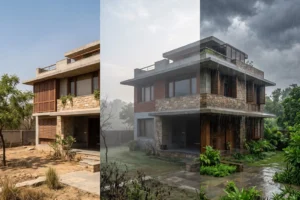
A composite climate combines different climatic conditions during different times of the year. It can be hot and dry during some periods, cold during winter, and humid during the monsoon season. Delhi and Chandigarh are examples of composite climate regions mentioned in the source. Buildings in these areas therefore need to respond to changing climatic conditions throughout the year.
Cold Climate
Cold climates experience very low temperatures, particularly during winter. Some regions also receive snowfall. Srinagar, Kashmir, Himachal Pradesh, and Manali are examples mentioned in the source. In Tamil Nadu, Ooty and Kodaikanal have much cooler climatic conditions compared with most other parts of the state. In cold climates, the main objective of building design is to retain heat inside the building and reduce heat loss.

Temperate Climate
Temperate climates generally have mild weather. Summers are not extremely hot, and winters are not extremely cold. Bangalore and Pune are examples mentioned in the source, along with some hill regions such as Yelagiri. Because the weather is relatively mild, designing buildings for a temperate climate can be comparatively easier than designing for extreme climatic conditions.

Architectural Response to Different Climates
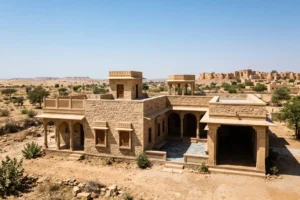
Different climates require different architectural responses. In hot and dry regions, buildings need to reduce heat entering during the day while retaining cooler conditions during the night. Thick walls and compact planning can help reduce heat gain. Smaller courtyards and windows can also be used, while light-coloured surfaces can reduce the impact of solar heat. Trees can provide additional shade around the building. In warm and humid regions such as Chennai, the approach is different. Cross ventilation becomes very important because moving air can improve comfort.

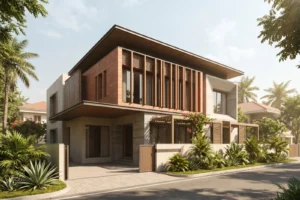
Verandas and balconies can provide shade, while deep roof overhangs and sunshades can reduce direct sunlight entering the building. Larger windows can help improve cross ventilation. High ceilings, courtyards, roof overhangs, and trees can also contribute to a more comfortable environment. In cold regions, the focus is on retaining heat. Insulated walls and double-glazed windows can help reduce heat loss. Larger windows on the south side can allow sunlight to enter during winter, while steep roofs can help deal with snowfall.
Understanding Chennai’s Warm and Humid Climate
Chennai is not simply a hot region. It is a warm and humid region. This difference is important because humidity plays a major role in how comfortable we feel. Warm and humid climates are particularly challenging for passive cooling because high humidity makes natural cooling more difficult. This is why mechanical methods such as fans and air conditioning are often required to achieve thermal comfort. Most of Tamil Nadu falls within the warm and humid region, although climatic conditions can vary between locations.

The Four Major Climatic Factors in Chennai
To design a building for Chennai, we need to understand four important climatic factors: temperature, humidity, solar radiation, and sea breeze. These factors influence how comfortable a building feels and how it should respond to the surrounding environment. A good climate-based design considers all of these factors together instead of focusing only on temperature.

Temperature and Solar Radiation
During summer, Chennai can experience temperatures of around 35°C to 42°C, and sometimes even higher. Because Chennai is located close to the equator, solar radiation is also an important consideration. The roof can receive significant heat, while western walls and windows can also experience strong solar exposure. This makes roof design, window design, shading, and building orientation important parts of climate-responsive architecture.
Humidity and Thermal Comfort
Humidity is one of the biggest challenges in Chennai’s climate. Our body naturally tries to cool itself through sweating. When sweat evaporates, it helps remove heat from the body and creates a cooling effect. The problem is that in a humid environment, sweat does not evaporate easily because the air already contains a high amount of moisture. This is why 35°C with high humidity can feel much more uncomfortable than 35°C in a dry climate. Air movement can help. A fan increases air movement around the body and helps sweat evaporate more effectively. Air conditioning also reduces humidity inside a room. This is one of the reasons an air-conditioned room can feel more comfortable during Chennai’s hot and humid weather.
Read More : Which Wall Material Is Best for Your House?

The Importance of Sea Breeze
Chennai has an important natural advantage: the sea breeze. Because Chennai is located close to the Bay of Bengal, sea breeze can provide useful air movement, particularly during the afternoon. Climate-based design should therefore consider how this natural breeze can be used to improve ventilation and comfort inside the building. Instead of treating the climate only as a problem, good architecture can also make use of the advantages that the local climate provides.

Wind Direction and Building Design
Wind direction can change depending on the season. Therefore, designing windows based on only one wind direction may not provide the best result throughout the year. The source discusses seasonal changes in wind direction and highlights the importance of studying climatic data before deciding the orientation of windows and rooms. During the summer months, south and south-east winds are identified as important breeze directions in the discussion. This shows why climate-based design should consider seasonal wind patterns rather than applying one fixed rule to every house.

Chennai’s Monsoon Pattern
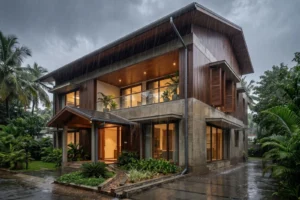
Rainfall is another important part of Chennai’s climate. In much of India, the south-west monsoon is a major source of rainfall. However, Tamil Nadu receives a significant amount of its rainfall from the north-east monsoon. According to the source, Chennai’s main monsoon period generally occurs from October to December, with a large share of the annual rainfall occurring during this period. During the north-east monsoon, Chennai can experience heavy driving rain. This can particularly affect balconies, windows, and other exposed areas of a building. Therefore, rain protection needs to be considered along with ventilation and shading when designing a house for Chennai.
How Chennai’s Weather Changes Throughout the Year
Chennai’s weather can be broadly understood by looking at different periods of the year. January to March is described as one of the more comfortable periods, with relatively pleasant weather. April to July is the hotter period, when temperature, humidity, and solar radiation are high. During this period, the summer breeze can provide some relief. From around July to September, the influence of the south-west monsoon in neighbouring regions can bring more clouds and some rainfall, providing relief from the intense summer heat. October to December is the main monsoon period for Chennai, bringing heavy rainfall and driving rain from the north-east. Understanding these seasonal changes is important because a building needs to remain comfortable and protected under different weather conditions throughout the year.

Psychological Comfort and Climate
Thermal comfort is not determined only by the temperature shown on a thermometer. People who live in different climatic regions can experience the same temperature differently because their bodies become accustomed to their local environment. The source explains that people in Chennai may feel comfortable at a different temperature range compared with people living in Bangalore or colder regions such as Europe and Ooty. This is known as the psychological comfort level. Understanding this concept is useful in architecture because the goal is not simply to achieve a particular temperature. The goal is to create an environment that feels comfortable to the people using the building.
Read More : Which Wall Material Is Best for Your House?

Why Climate-Based Design Matters for Chennai Homes
Chennai’s climate cannot be understood simply by saying that the city is hot. The combination of high temperature, high humidity, strong solar radiation, seasonal wind patterns, sea breeze, and heavy monsoon rainfall creates a unique set of challenges for building design. A house designed around these conditions can make better use of natural ventilation, shading, airflow, and other climatic advantages. Climate-based design allows architects to respond to the actual environment of a location instead of applying the same design approach everywhere.

From Climate Understanding to Building Design
Understanding the climate is only the first step. Once we understand Chennai’s temperature, humidity, solar radiation, wind direction, sea breeze, and rainfall patterns, the next step is to translate this information into practical architectural solutions. Building orientation, windows, shading, roof design, courtyards, balconies, ventilation, and other design elements can all be planned according to the local climate. The next stage is to understand how these climatic advantages and challenges can be converted into practical design strategies for homes in Chennai and Tamil Nadu. This forms the focus of the second part of the climate-based design discussion.

Conclusion
Climate is an important part of good architectural design. For Chennai and most parts of Tamil Nadu, understanding the warm and humid climate is especially important. High temperature, humidity, solar radiation, seasonal wind patterns, sea breeze, and monsoon rainfall all influence how a home should be designed. Instead of simply fighting the climate, architecture can respond to it intelligently. By understanding the local climate and using that knowledge during the design process, we can create homes that are more comfortable, more energy-efficient, and better suited to their environment.
Watch the full video on YouTube for detailed insights :